8 Reasons Your Business Card Gets Tossed After a Mississauga Networking Event
You handed out twenty cards at that event in Mississauga last Thursday. You felt good about it. You had conversations, made eye contact, and followed up with a firm handshake.
But here is the honest truth that nobody wants to tell you: most are already in a recycling bin.
It is not because you were forgettable. It is because the card was.
A business card is the only piece of you that stays in the room after you leave. When it fails to do its job, it does not just sit quietly in someone’s pocket; it actively works against the impression you worked so hard to build. That stings, and it is completely avoidable.
The good news is that the reasons business cards get discarded are almost always the same. And those reasons are predictable, fixable, and entirely within your control before you ever place a print order.
In this blog, we will talk about the eight reasons why your business card gets tossed after a networking event in Mississauga and help you make a card worth keeping.
8 Reasons Your Business Card Ends Up in the Bin and How to Stop It
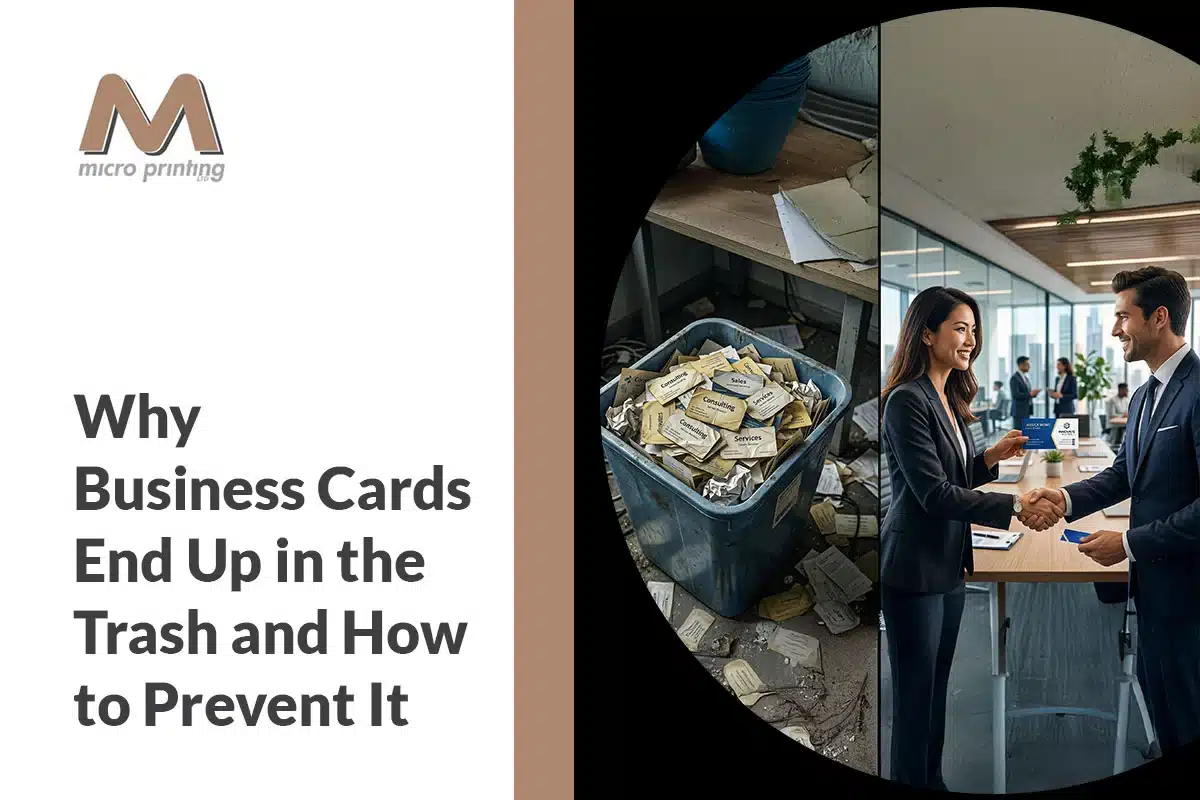
The problems start long before the event. Here is what is quietly killing your first impression.
1. The Card Feels Cheap
There is a split second when someone takes your card, and their fingers tell their brain what to think. If the card bends easily, feels thin, or has that slightly flimsy quality of paper that was never meant to last, the message is immediate: this person did not invest in themselves. Paper weight is not a minor detail. It is the first handshake your card gives without you in the room.
Standard business cards in Mississauga, printed on 14-point cardstock, are on the lighter end of acceptable, but the difference between that and 16-point or 32-point is felt instantly. Heavier stock communicates durability, confidence, and care.
Moreover, when your card sits in a pile with others collected at the same event, a thicker, more substantial card rises to the top, literally and figuratively. The investment in better stock is genuinely modest, and the return on that investment, in terms of the impression it leaves, is significant. Do not let flimsy paper quietly undercut the credibility you spent years building.
2. The Information Is Cluttered or Impossible to Read
People are busy. When someone picks up your card after an event, they are often shuffling through a stack of them. They may be tired and on the move. If your card requires effort to read i.e., if the font is too small, the text too dense, or the layout too crowded, it gets put down. Not filed. Not photographed. Put down and forgotten.
A business card is not a brochure. It is not the place to list every service, every social media handle, every credential, and every phone number you have ever owned. It is a focused, curated piece of communication. Your name, your role, one phone number, one email, and your website is enough.
When a designer tries to fit too much onto a 3.5 x 2-inch card, the font size shrinks, the margins disappear, and the whole thing starts to feel anxiety provoking. White space is not wasted space. It is the breathing room that makes your key information easy to find and pleasant to look at.
3. There Is No Visual Reason to Look Twice
Imagine going home after a networking event and emptying your jacket pocket onto the kitchen table. You have eleven cards in front of you. One is a bright, well-designed piece with a clean layout and a thoughtful use of colour. The rest are white rectangles with black text. Which one do you look at first? Which one do you remember?
This is not about being flashy for the sake of it. It is about giving someone a reason to pause. Colour plays a powerful role here. The conventional white-on-white approach is safe, but safe does not make you memorable. Even a well-placed brand colour on one side of the card, or a thoughtful background tone, changes everything. For instance, deep navy, rich burgundy, or forest green used deliberately can communicate professionalism and personality at the same time.
Printing business cards in Mississauga gives you full-colour options that are sharp, consistent, and far more arresting than a plain white stock card. Use that option. Give people a visual reason to hold onto yours.
4. The Finish Does Not Match the Brand You Are Selling
The finish of your card—be it matte, gloss, or uncoated—is not just an aesthetic choice. It is a brand signal. A gloss finish says vibrant, modern, and high energy. A matte finish says refined, sophisticated, and considered. An uncoated finish says approachable, tactile, and honest. When the finish contradicts the message of the business, people feel the disconnect even if they cannot name it.
For instance, a luxury real estate agent handing out a glossy card with a busy design sends a mixed message. A creative studio handing out a flat white card with no personality sends another. The finish must work in harmony with your brand’s colours, fonts, and overall tone.
The right finish also affects readability and durability. Matte stock holds its look well over time and does not show fingerprints. Gloss stock makes photography and colour-heavy designs sing. Thinking this decision through before you print saves you from a card that feels slightly off without anyone being able to say exactly why.
5. One Side Is Left Completely Blank
Leaving the back of your business card empty is one of the most common missed opportunities in professional printing. You have a full side of prime real estate, and you are handing it over blank. That empty back is the visual equivalent of a shrug.
The back of a card does not need to be loud or complicated. A simple brand tagline, a clean image, or a QR code that links to your portfolio can all give the card a finished, intentional quality. Alternatively, you could feature just your logo centred on a coloured background. They also give the person receiving it something to look at when they flip it over, which keeps them engaged for a few extra seconds. Those seconds matter.
A card with a well-designed back feels like a complete object. It feels considered. It tells the reader that you care about the details of your work, which is exactly the kind of professional you want to be known as. Business card printing in Mississauga is affordable enough that designing both sides costs very little more than printing one.
6. The Card Has No Clear Next Step
A business card that does not tell someone what to do next is a missed opportunity dressed up as a polished piece of print. You met someone at an event. They took your card. Now what? If the answer is not immediately obvious from the card itself, you have lost the momentum of that meeting.
A proper call to action does not have to be aggressive or salesy. It can be as simple as a website address that is easy to type, a QR code that goes directly to your booking page, or even a short line like “Let’s connect over coffee” printed beneath your contact details. The point is that the card should carry the conversation forward.
For instance, a consultant whose card says nothing beyond name and phone number forces the recipient to decide on their own what the next move is, and most people won’t bother.
In a digital world where people scan and save information quickly, having a visual prompt that makes the next step obvious is a simple, effective way to turn a printed card into an actual lead.
7. The Design Was Done Without a Printer in Mind
This is a problem that happens upstream, before a single card gets printed, and it causes some of the most frustrating outcomes in the whole process. A design that looks pretty on a screen can print poorly if it was not built with print specifications in mind. Colours shift. Fonts that look sharp digitally can appear soft on certain paper stocks. Elements too close to the edge get trimmed off.
Professional business card printing in Mississauga requires artwork set up with proper bleed (usually 0.125 inches on each side), correct colour mode (CMYK rather than RGB), and a resolution of at least 300 DPI. When these technical requirements are ignored, the printed result never quite matches the expectation, and the card ends up looking slightly off; hard to pin down but easy to feel.
Working with a printer who reviews your files before going to press catches these issues before they become expensive mistakes. Furthermore, understanding these basics, even at a high level, makes you a more informed client and gives you more control over the final product.
8. The Card Looks Like It Was Printed at Home
There is a quality difference between professionally printed cards and those run off on a desktop printer, and it is immediately obvious to anyone who handles both. Home-printed cards often have uneven colour, visible banding, soft edges, and a surface that smudges. Even if the design is strong, the execution tells a different story.
Standard business cards produced by a professional shop are printed with calibrated equipment, consistent colour management, and materials that are purpose built for the job. The result is a card with clean lines, solid colour density, and a professional feel that holds up.
Moreover, the cost difference between doing it yourself and having it done properly is smaller than most people expect. For the volume of cards most professionals use in a year, the per-card cost at a reputable print shop is genuinely affordable.
The decision to print professionally is not about luxury but about making sure the first physical thing someone holds that represents your business represents it well.
What to Look for When You Are Ready to Order
Knowing why cards fail is half the battle. Here is what to focus on when you are ready to get it right.
1. Choose Your Card Type Based on Your Industry, Not Just Your Budget
Not every business needs the same type of card, and choosing wisely here makes a real difference to how your card lands. A standard business card on quality stock is the right starting point for most professionals: clean, versatile, and universally accepted.
But certain industries benefit from stepping up from those basics. A photographer, architect, or brand consultant, for instance, might find that a spot UV card where a glossy coating highlights specific design elements adds exactly the kind of visual sophistication their clientele expects. A contractor or outdoor services professional might be better served by a plastic business card, which is waterproof and far more durable than paper.
Thinking about where your card will live? Is it in a desk drawer, a wallet, a toolbox, or an apron pocket? This helps you choose the format that will still look good weeks after the event where you handed it out.
2. Cardstock Is a Brand Decision, Not Just a Printing Decision
When you sit down to order, the choice of cardstock deserves real thought. Matte stock gives a minimal, sophisticated look that feels premium without being loud about it. Gloss stock makes colours pop and is ideal when your card uses photography or bold graphics. Uncoated stock has a natural, tactile quality that works well for brands that want to feel approachable and honest. Then there are heavier luxury stocks, like 32-point and above, that communicate a genuine commitment to quality the moment someone holds your card.
The paper you choose should feel like a natural extension of the rest of your brand. If your website is clean and minimal, your card should be too. If your brand is warm and tactile—like a bakery, a wellness practice, or a boutique—an uncoated or textured stock reinforces that feeling in a way that gloss simply does not. Business card printing in Mississauga offers all these options, so there is no reason to default to whatever is cheapest if it does not serve your brand well.
3. Work With a Printer Who Will Catch Problems Before They Go to Press
One of the most valuable things a good print shop does is flag issues before the job runs. A misaligned bleed, a font that has not been outlined, a colour that will shift dramatically from screen to paper—these are things an experienced printer sees every day and can fix in minutes if caught early. If they go unnoticed, you end up with a batch of cards that cost you money and still do not represent you well.
When you are looking at options for printing in Mississauga, it is worth asking whether the shop reviews files before printing, whether they offer a proof, and whether they have staff who can walk you through material choices. That kind of attentive service is not universal, and it makes a genuine difference in the outcome.
A printer who takes the time to understand what you are trying to achieve—not just what file you have sent—is one worth building a relationship with. Good printing is a partnership, not just a transaction.
4. Order Enough Cards
This one sounds simple but it trips people up more than you would think. Running out of cards at an event is an awkward moment that is entirely preventable. Worse, some professionals print so few cards that they become reluctant to hand them out freely, which defeats the purpose entirely.
The cost per card drops significantly as volume increases, so ordering a sensible quantity (think 250 or 500 cards rather than 50) is almost always the more economical choice per unit. Standard business cards are not a scarce resource; they are a tool, and tools work best when you use them freely and confidently.
Having a proper supply on hand means you are never caught off guard, whether that is an unexpected conference, a chance encounter at a coffee shop, or a client who asks for a few extras to pass along to colleagues. Order enough to be generous. That generosity in itself leaves an impression.
A business card does not need to be extraordinary to work. It needs to be intentional. When the paper feels right, the information is clear, and the design reflects the care you put into your work, people hold onto it. They put it on their desk. They take a photo of it. They pass it along. Business cards in Mississauga are not a relic of a pre-digital world. They are a physical proof of who you