Large Format Printing for Toronto Businesses: 5 Reasons Trade Show Displays Fail and How to Fix Them
Trade shows are expensive. The booth fee, the travel, the staff time, and the materials all add up fast. Yet many businesses walk away without a single solid lead and cannot quite figure out why.
The truth is that most trade show failures happen long before the event begins. They happen at the design stage, the material selection stage, and the printing stage. But these are fixable problems—and fixing them is not complicated.
What separates a booth that draws a crowd from one that gets ignored is almost always the quality and clarity of the visuals. A great display does not just look good. It communicates your value in about three seconds flat.
Here, we will discuss five reasons why trade show displays fail and what Toronto businesses can do to fix them when considering large-format printing.
Why Trade Show Displays Fall Short and What You Can Do About It
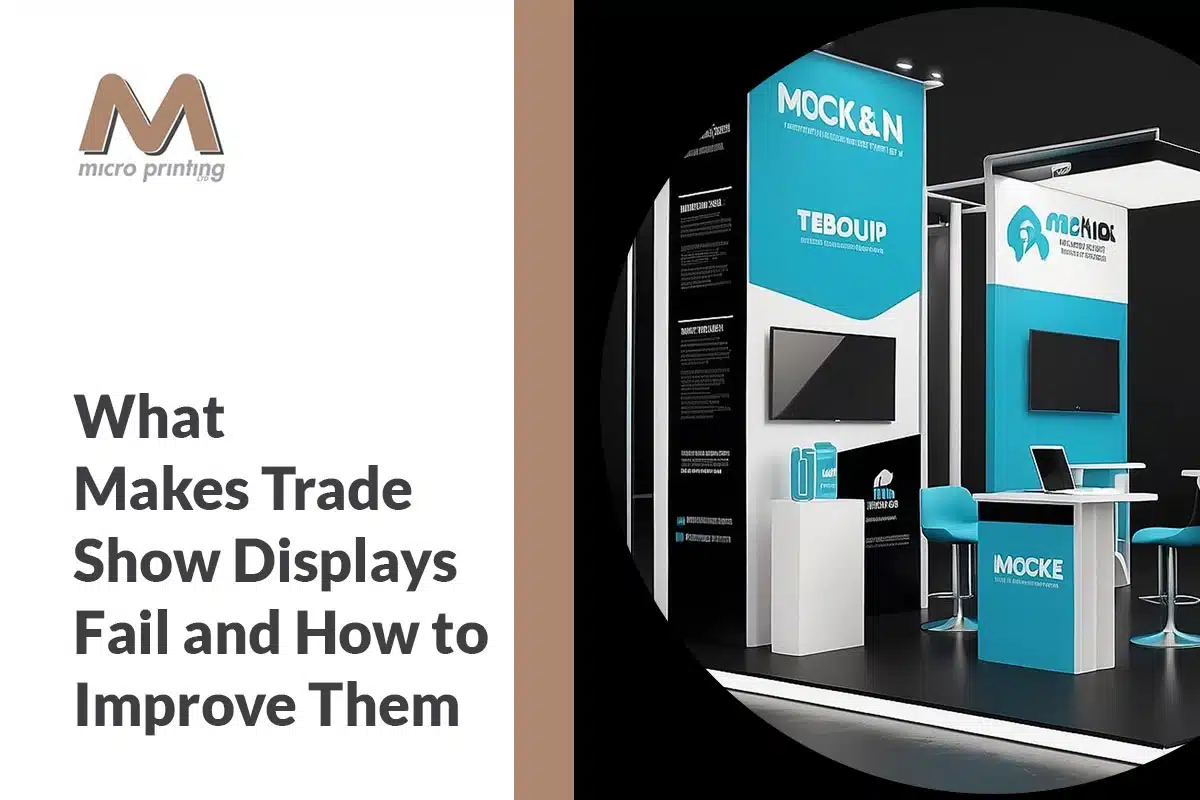
Most display problems come down to a few repeated mistakes. Here is a detailed breakdown of what goes wrong and how to get it right.
1. Reason 1: The Message Is Too Cluttered
A trade show floor is loud, bright, and full of competing visuals. When someone walks past your booth, they give it roughly two to three seconds of attention before moving on. If your display is covered in dense text, multiple taglines, and a long list of services, their eyes will not know where to go and they will simply move on.
The fix is simple: lead with one clear idea. Your display should answer two related questions for the viewer: “What do you do and why should I care?” Everything else is noise. Choose a single headline that speaks directly to your customer’s biggest problem or desire. Keep supporting text to a minimum. Use bold, easy-to-read fonts at a size that can be read from at least three metres away.
A cluttered display often signals a lack of confidence in the core offer. When a business is not sure what its strongest selling point is, it lists everything and hopes something sticks. That approach rarely works in a busy event environment. Work out your strongest single message before you even think about design. Your display will be stronger for it.
2. Reason 2: The Print Quality Does Not Hold Up at Scale
A design that looks sharp on a laptop screen can fall apart completely when it is printed at banner size. This is one of the most common and most painful surprises businesses face at trade shows. They approve a proof on screen, pick it up from the printer, and only realize the problem when the banner is already hanging at the booth.
The root cause is almost always resolution. Images meant for digital screens are typically 72 DPI (dots per inch). For large format printing in Toronto, professional-grade output requires artwork at 100 to 150 DPI at full print size, and sometimes higher for close-viewing displays. When a low-resolution image is scaled up, it goes soft and pixelated. Logos lose their sharpness and photos look smeared.
Vector files for logos and graphics are essential as they scale to any size without losing quality. If your designer has only ever given you a PNG or JPEG logo, ask for the original vector file before your next print job. Working with a knowledgeable printing company in Toronto that reviews file quality before going to press will save you from this problem entirely.
3. Reason 3: The Wrong Materials Were Chosen
Not all trade show displays are used in the same way. Some are set up indoors under bright LED lighting. Others are placed near windows with direct sunlight. Some need to be rolled up and transported in a tube dozens of times a year. The material you choose for your display needs to match how it will be used.
For instance, a vinyl banner printed for outdoor use will look perfectly fine outside, but indoors, under artificial lighting, it can produce an unwanted glare that makes the text hard to read. A fabric display, on the other hand, absorbs light evenly and looks polished in an indoor setting. Retractable banner stands need a specific type of media that is flexible enough to roll without cracking but stiff enough to stand flat.
For this reason, the conversation with your printer should always start with how and where the display will be used. A good printer will ask these questions before recommending a substrate. The material choice affects not just the look of the final product but also its lifespan. Choosing the right material from the start means your display lasts through multiple events without fading, creasing, or tearing.
4. Reason 4: The Branding Is Inconsistent Across Pieces
Walk into a trade show and look at the booths that feel polished versus the ones that feel thrown together. The polished ones have a consistent visual thread running through every single piece. The table cover, the retractable banner, the poster on the back wall, and even the business cards all feel like they belong to the same family. That’s because the colours, fonts, and tone match.
Thrown-together booths have a different problem. Perhaps one piece was made two years ago while another was made last month. Or the logo is a slightly different shade of blue on each one and the fonts are different. Nothing feels cohesive. Even if each individual piece is decent on its own, together they send a subtle signal that the business is disorganized.
The fix is to treat your trade show display as a system, not a collection of individual items. Produce all your pieces together, at the same time, from the same printer. This ensures colour consistency across substrates.
Printing companies in the Toronto area that handle large format and smaller format work under one roof can match your brand colours across banners, posters, and printed collateral with much greater accuracy.
5. Reason 5: The Display Was Designed Without the Space in Mind
A 10-by-10 foot booth and a 20-by-20 foot booth are completely different environments. A display built for a large corner space will look sparse and awkward crammed into a small inline booth. A display designed for a tiny space will feel overwhelmed and incomplete in a larger footprint. Many businesses design their trade show graphics without knowing their exact booth dimensions, and it shows.
Beyond the booth size, the height of the ceiling matters. Some venues have low ceilings that make tall tower displays impractical. Others have high ceilings where a taller backdrop is a competitive advantage.
The flow of foot traffic in the hall also matters. If your booth is on the left side of a main aisle, most attendees will approach it from their right. Your most important message should be visible from that angle.
Plan your display layout around the specific dimensions of your booth space every single time. If you are printing new displays for an upcoming event, give your printer the exact measurements. A skilled team working in large format printing for Toronto businesses will help you plan a layout that uses every inch of your space effectively and strategically.
How the Right Print Partner Makes All the Difference
Even with a solid plan and strong artwork, the outcome of your trade show display depends heavily on who prints it. Here is what a genuinely capable print partner brings to the table.
1. They Review Your Files Before Printing
A good printer does not just take your file and run it. They check the resolution, the colour profile, the bleed, and the overall print-readiness of your artwork before a single drop of ink touches the substrate. This step alone prevents most of the quality problems that businesses catch too late. At Micro Printing, file review is part of the standard process, not an add-on.
This matters because the cost of catching a problem before printing is zero. The cost of catching it after is the full reprinting fee plus lost time. If you are working against a deadline, as most trade show clients are, that lost time can be devastating. A printer that takes file quality seriously is a printer that respects your budget and your schedule. Furthermore, they will communicate clearly if something needs to be fixed rather than printing a substandard job just to meet a quota.
2. They Offer Same-Day and Rush Production
Trade show timelines are unforgiving. Sometimes a display gets damaged in transit, or a last-minute event opportunity comes up with only a day or two of lead time. Having access to a printer that can handle urgent production without sacrificing quality is genuinely valuable.
Large format printing costs go up with rush jobs, and that is fair. But the ability to get a high-quality banner or display printed on short notice is worth understanding before you need it. The worst time to find out your printer cannot do same-day work is the morning before an event.
Micro Printing offers same-day production for qualifying jobs, which gives clients a real safety net when time is tight. Knowing that option exists changes how you plan and how much risk you carry going into a busy event season.
3. They Handle a Full Range of Display Products
A trade show presence is rarely just one piece. It is a backdrop, a retractable banner, a table cover, a poster or two, and sometimes a floor graphic or window cling. Working with a printer that handles all of these under one roof means your colours stay consistent and your communication stays simple.
Splitting your order across vendors introduces risk. Each printing company Toronto businesses use may have slightly different colour calibration, different substrates, and different production standards. When you consolidate your trade show printing with one capable shop, you get a cohesive result via a single point of contact. Micro Printing handles banners, posters, exhibition displays, and a range of large format products, which makes consolidation practical and straightforward.
4. They Bring Experience with Trade Show Specifications
Different trade show venues and event organizers have different requirements for display materials. Some require flame-retardant substrates. Others have rules about hanging hardware or display height. A printer with experience in the trade show space will already know these requirements and will flag them for you before production begins.
This is where experience pays off in a very direct way. A printer that has produced thousands of trade show displays has seen the edge cases, the venue-specific quirks, and the last-minute specification changes. They will ask the right questions upfront, so you are not caught off guard on setup day. For any business investing in trade show displays for an upcoming event, working with an experienced team is not a luxury but a practical, cost-conscious choice.
Trade show displays fail for reasons that are almost always preventable. Cluttered messaging, poor print quality, wrong materials, inconsistent branding, and ignoring booth dimensions are the five biggest culprits. Fortunately, each one has a clear, actionable fix, and most of those fixes start with making smarter decisions earlier in the process. Large format printing for Toronto businesses is not just about size. It is about producing something that works hard for you. Micro Printing is one name worth knowing when you are ready to get it right.